Showing posts with label Natasha Cardinez. Show all posts

Friday, August 31, 2012

Cooking in Barcelona

At this point, we had been in Barcelona for only three days but taxis had become our primary means  of transportation. Barcelona's climate is oppressive in August.  An otherwise leisurely twenty minute walk is made unbearable by the heat and humidity, even at eleven o'clock in the morning.

Joining us this morning were two of our friends from Minneapolis who had been living and working in Barca for the past year, and who have somehow rapidly adapted to the heat. We boarded the taxi at the corner of Madrazzo and Valmis, an intersection marked by the a local hospital and relatively modern buildings. The cab driver was soon maneuvering through cobble-stoned streets, barely wide enough for his Spanish-made Astra. We slowly drove past ornate hardwood doors and brightly colored store fronts bordered by wrought-iron lamps, and flowers baskets hanging from windows and spilling over with brightly colored vines and blossoms.  We had come to this part of town for a lesson in Catalan cuisine. And I was ready to learn about and savor the favors of Spain!

Clams for the paella. 

Chef Alesandra getting the paella started. 

Espai Boisa is run by Claudia Schmilinsky and Pep Soler, a husband and wife team with a desire to teach locals and travelers alike about Spanish and Catalan cuisine.  From the prawns and clams for the paella, to the tomatoes and olive oil for the pan con tomate, and the red and white wines that Pep so generously refilled throughout the class -  all ingredients were fresh, organic, and sourced locally.

Catalonia, of which Barcelona is the capital, is the northeastern most region in Spain with a cuisine distinct from other regions. Claudia and Pep and their chef Alesandra prepared a menu of both Catalan and other regional dishes: spanish tortilla, bacon wrapped stuffed dates, pan con tomate, gazpacho, paella, and crema catalana.

 Preparing pan con tomate.

 The finished paella. 

 Crema catalana.

The class started with introductions, followed by a quick description of each dish by Alesandra. Our first appetizer, the spanish tortilla, is an egg dish made in a non-stick skillet and filled with potatoes and onions cooked confit-style. Certainly, not your ordinary breakfast eggs. The other appetizer was dates stuffed with almonds and wrapped in bacon before finally being roasted in the oven - a simple hor d'oeuvre which I took note to make at home at my next casual dinner party, served with a pitcher of homemade sangria perhaps. A third appetizer was pan con tomate, simply slices of fresh bread rubbed with fresh tomatoes and finished with sea salt and olive oil. Then there was gazpacho. Alexandra makes her gazapacho with tomatoes, onions, watermelon, lemon juice and olive oil. This, we later learnt, is a slight variation from the traditional gazapacho which includes day-old bread.  Our main dish was paella which is not Catalan, having originated in the Valencia region, but what cooking class in Spain would be complete without Spain's most popular dish? Dessert was crema catalana, a dish similar to creme brulee with a couple notable differences. Crema catalana is made with whole milk and the custard is finished on the stove-top; creme brulee is made with cream and the custard is finished in the oven.

While Alesandra relayed instructions, members of the class (on this day there were fourteen of us) began the chopping and dicing process, getting the ingredients ready for their respective dishes. We all  had different tasks: a couple people supervised the potatoes-confit for the spanish tortillas, some worked on the gazpacho but everyone got a chance to help with the paella. Seemingly, we all gravitated to the large paella pot in the center of the cooking station, a point that Alesandra took notice of and expounded on. Paella, she explained, is a dish that's meant to be shared and those restaurants that serve individual paellas deviate from the true meaning of the dish. I liked her narrative. I have a strong proclivity for tradition when it comes to food,  so I respected her efforts to incorporate her values in the class.

With Claudia and Pep. 

Two and a half hours passed quickly amidst the the chatter, the culinary education, and the good wine. Claudia and Pep were the most gracious hosts, having done a superb job of facilitating a warm, welcoming environment.  While fourteen people is a lot for one cooking class, I felt that it made for an interesting mix of backgrounds and conversation. In the end, we all had one thing in common: an appreciation of healthy, wholesome, and delicious food. So, if you ever make it to Barcelona, try and include a cooking class from Espai Boisa on your agenda. If I return, I'd do it again.

To view more photos, click here for our Facebook page.
For more information about Espai Boisa, click here.

Recipes:


Bacon Wrapped Dates
(8 ounce) package pitted dates 
4 ounces almonds
1 pound sliced bacon
Directions
Preheat the broiler. Slit dates. Place one almond inside each date. Wrap dates with bacon, using toothpicks to hold them together. Broil 10 minutes, or until bacon is evenly brown and crisp.


Traditional Gazpacho
Serves 4
100g slightly stale crusty white bread, soaked in cold water for 20 min. 
1kg very ripe tomatoes, diced 
1 ripe red pepper and 1 green pepper, deseeded and diced 
1 medium cucumber, peeled and diced
2 cloves of garlic, peeled and crushed 
150ml extra virgin olive oil 
2 tbsp sherry vinegar 
Salt, to taste
Lemon juice, to taste
Directions1. Mix the diced tomatoes, peppers and cucumber with the crushed garlic and olive oil in the bowl of a food processor or blender. Squeeze out the bread, tear it roughly into chunks, and add to the mixture. 2. Blend until smooth, then add the salt and vinegar to taste and stir well. 3. Pass the mixture through a fine sieve, then cover and refrigerate until well chilled. 4. Serve with garnishes of your choice: I liked diced black olives, hard- boiled egg and small pieces of cucumber and pepper; mint or parsley also works well, and many people add spring onion, cubes of Spanish ham and so on.

Crema Catalana or Catalan Cream
Crema Catalana or Catalan Cream is the Catalan name and version of the French dessert, crème brulée. In fact, many regions lay claim to the origin of the dessert. Wherever it originated, enjoy and let it dissolve in your mouth! It is a great dessert for Spring, since it is also called Crema de Sant Josep, or St. Joseph’s cream, traditionally prepared on March 19th, St. Joseph’s Day, the Spanish equivalent of Father’s Day in the USA.
Yield: 4 Servings 
Ingredients: 
1 cup sugar
4 egg yolks
1 tbsp cornstarch
1 stick cinnamon
grated rind of 1 lemon 
2 cups milk
Directions: This is a great dessert to make ahead of time, since it is very easy and requires 2-3 hours of refrigeration before serving. Make it the day before and leave it in the refrigerator until you are ready to serve. Then, heat the broiler, caramelize the sugar and serve! In a pot, beat together the egg yolks and 3/4 cup sugar until thoroughly blended and the mixture turns frothy. Add the cinnamon stick and grated lemon rind. Pour in the milk and cornstarch. Slowly heat the mixture, stirring constantly, just until thickened. Remove pot from heat immediately.
Tip: As soon as the mixture thickens and you feel resistance while stirring, remove the pot from the heat or the mixture may curdle or separate! The texture of the finished crema will be grainy instead of smooth and creamy as it should be. Remove the cinnamon stick and ladle the milk mixture into 4-6 ramekins (depending on size). Allow to cool, then refrigerate for at least 2-3 hours.Before serving, preheat the broiler. Remove ramekins with the crema catalana from refrigerator and sprinkle the rest of the sugar over each ramekin. When broiler is hot, place the ramekins under the broiler on the top shelf and allow the sugar to caramelize, turning gold and brown. This may take 10 minutes or so, depending on your broiler. Remove and serve immediately.If you'd like, you can serve the crema catalana chilled, but we think it has more flavor when served warm from the broiler.

Tuesday, June 12, 2012

Sweet and Salty Pecans


Sweet and Salty Pecans. 

My sister, Nancy, recently visited us for a couple days last month. Even though we talk practically everyday, thanks to Skype, it had been almost six months since we last visited each other. She lives in Toronto, I live in Minneapolis, and we both have busy lives, so our visits with each other have become rare over the years. I get a little nostalgic when I think about it because we are only one and a half years apart in age, and were inseparable while growing up.  We have so much in common: our passion for the beach, cooking, history, culture, and our impatience, to name a  few.

Nancy, however is a better gardener than I am. To my great benefit,  she offered to help me with my summer planting projects. Three trips to the garden shop, and many bags of potting soil later, my back yard patio space and deck look brilliant.

One of a few combination flower pots Nancy and I created. 

Nancy is also a fan of all things nutty: chocolate and peanut butter ice cream, peanut brittle, chocolate covered nuts, etc.  I, on the other hand, if given another choice, would readily forego nutty flavored foods.  But just add some salt and some sugar to pecans or walnuts, and I can't help myself. This is my recipe for sweet and salty pecans which are good on their own but also are a nice extra on salads.


Sweet and Salty Pecans

2 egg whites
1 lb pecans
1 cup sugar
1 1/2 tbsp salt
2 tbsp ground pepper

1. Set the oven to 250 °F. Spray a large baking sheet with cooking spray and set aside.
2. In a large bowl, whisk the egg whites until frothy. Add the pecans toss thoroughly to coat.
3. In another bowl, combine the sugar, salt, and pepper. Pour unto the egg white covered pecans and combine well, making sure that all of the pecans are properly coated with the sugar mixture.
4. Spread evenly unto the prepared baking sheet into a single layer. Bake at 250 °F for an hour.
5. Remove from the oven and allow to cool completely.

Thursday, March 1, 2012

Individual Black Forest Trifles


Proverbial it may be, the sweet tooth is a genetic trait that runs deep in my family. I have tried but learned long ago that any attempt to suppress a sweet tooth is futile. So I've come up with ways to have dessert without undoing all my efforts at healthy eating. I try only to bake on the weekends - which does not always work out - and portion control - a more feasible approach.

Few desserts are more elegant than an expertly assembled black forest cake. The mounds of white, fluffy whipped cream, contrasted with shards of brown chocolate and bright red maraschino cherries all make a black forest cake a dreamy sight. The problem is: in my house, a cake of this calibre would be devoured in an embarrassingly short amount of time. This is where portion control and single serving sizes come in.

The following recipe makes approximately six to eight individual trifles. I usually use this recipe from Ina Garten for the chocolate cake but, as suggested, you can use a chocolate cake of your choice. A huge convenience is cutting the cakes into cubes and storing them in the freezing so that they are on hand for whenever I get a craving for something sweet, which is usually quite often.


Individual Black Forest Trifles
Serves 6 to 8

1 jar morelo cherries, in syrup
1/2 cup sugar
2 tbsp cherry brandy (optional)
2 cups heavy cream
1 cup confectioner's sugar
2 tbsp vanilla extract
1 pound chocolate cake of your choice, cut into 1/2" cubes
dark chocolate shavings
6 to 8 3oz servings glasses


1. Drain the cherries, saving the liquid and reserving the cherries separately. Add the liquid to a sauce pan, together with the cherry brandy (if using) half cup of sugar. Simmer until thickened and reduced by half. Allow to cool then combine with the reserved cherries, and set aside.
2. Whip the cream, confectioner's sugar, and vanilla together until fluffy, with stiff peaks.
3. To assemble the trifles, place about 4 cubes of cake on the bottom of each individual serving glass. Top with two tablespoons of the cherries followed by two tablespoons of whipped creamed. Repeat each layer ending with the cream. Dust the top of each trifle with chocolate chards before serving.

Sunday, November 8, 2009

Learning About Coffee on Hawaii's Big Island

My kitchen counter is scattered with one-pound bags of one hundred percent Kona coffee, jars of real Hawaiian honey, and packets of chocolate-covered macadamia nuts. In other words, my kitchen is a mess and I am too tired to do anything about it. But I have an excuse: jet lag. We spent the last twelve days exploring Hawaii's Big Island (the last of the four major islands I had yet to visit) starting with three days in Hilo, two days in Volcano Village and summing up the final seven days on the Kona side.( Yes, we enjoy the islands so much that we decided to do a second trip this year. ) This trip was supposed to be different from the others, and rightly so, since the big island itself is unlike the other islands. The youngest, the largest, home of the tallest mountain in the world (measured from its sea base), home of a flowing volcano, and home of the world's best coffee - hence the bags of beans on my counter.

The Kona coast is known for having the ideal combination of environmental factors for growing coffee. So clearly there would be numerous coffee plantations along this side of the island. Touring one of these plantations has become a part of the tourism industry. We decided to tour Greenwell Farms for a couple reasons: 1) it was recommended by Big Island Revealed (remember, this series is my holy grail for everything Hawaii), and 2) they are a family run business, started in the late 1800's and still functions today as a pesticide free production.

Fresh coffee beans removed from outer shell.

On the day we visited, we were immediately greeted by one of the tour guides and offered cups of freshly brewed coffee; not a bad way to start any tour. While the tour lasted a mere thirty minutes or so, we were able to follow the coffee bean from the tree to all the way to the drying process. I have a special fondness and respect for the agrarian lifestyle. In fact, my grandmother worked on a coffee plantation in Trinidad for many years. Even so, I never knew that ripe coffee beans, called coffee cherries, were actually very sweet with a gelatinous texture, somewhat similar to a grape. And that the bean itself is surrounded by three outer layers: the exocarp (the skin itself), the mesocarp (the soft, sweet layer beneath that) and the endocarp (the last, parchment-like layer covering the bean itself.) The ripe coffee cherries are gathered into a pulping mill where the first two layers are removed. Now, the product is called "wet parchment." Once the final layer is removed, the beans are then dried on large, flat beds with movable roof-like tops. Now called "dry parchment", the beans are then allowed to rest for up to thirty days to allow their natural moisture to evenly distribute which allows for uniform roasting. We weren't allowed into Greenwell's roasting facility but we did get to sample their various roasts, along with macadamia nuts and local honey.

Coffee beans are dried manually on large flat beds with movable roof tops.

After only thirty minutes in the sun, even with a hat and sunglasses, I will never again complain about handing over twenty plus dollars for a pound of good coffee. For even though Greenwell has adopted modern farming practices, every coffee cherry is hand picked! Yes, hand-picked by men and women in eighty degree heat. Added to that, the beans are not mechanically dried on those flat beds; it again takes human labor to spread them out into an even layer and to constantly re-mix and re-spread each batch to allow even drying. That's a lot of hard work! Greenwell's beans are only available for purchase at the plantation and on their website.

Branches of a coffee tree weighed down with green coffee cherries.

This tour was definitely one of the highlights of our trip but not the only one. Below are some photos from our hike across Kilauea Iki Crater, a two hour trek through rain forest, a volcanic crater, with views of the active side of this same volcano, and glimpses of endemic flora and fauna.

Made it out of the rain forest and about to trek across Kilauea Iki Crater.

There once was a road here.

In Thurston Lava Tube.

Wednesday, July 15, 2009

The Road to Hana


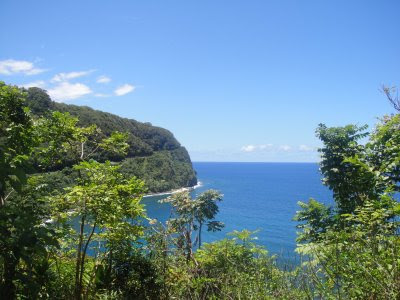
Ke'anae Coastline.

The above picture was taken at the Ke'anae coast and shows the coastline of that low-lying town has not changed much as compared to a thousand years ago. The one below shows a road seemingly cutting a densely forested peninsular in half. Both pictures were taken on the road to Hana in Maui. Last week I returned home after spending two idyllic weeks in Hawaii: five days in Oahu and nine days in Maui. Idyllic because the weather was perfect, it was off peak season so lines everywhere were short, and, for the first time, we did the drive to that quaint, quintessentially tropical town of Hana. The Road to Hana, as the entire endeavor is sometimes referred to, i.e. the drive, the many stops along the way, the distinctive foods- home made banana bread, lilikoi, papayas, mangoes, steamed breadfruit- that must be bought, the town itself, and the drive back can be a day long trip. We, on the other hand, decided to make it three days and two nights. And wisely so. After hearing stories and reading about the constant turns and downhills maneuvers on the Hana highway coupled with the fact that just the thought of all the curves is designed to give me notion sickness, I know we made a wise decision.

Hana Highway along east Maui.

We arrived in Kahului after four activity packed days on Oahu: kayaking, touring the LOST sights, snorkeling, touring the north coast. So by this time, we were ready for the laid back scene that is most of Maui. Kahului is a small port city and an airport town; consequently it is very commercialized and there aren't many good beaches, although some are within driving distance. This is not to say that I would overlook the town. In fact, I am always srtuck at the view of the West Maui mountains from here, its grandeur and yet its peacefulness. This time, however, Kahului served as our first pit stop before Hana. We'd have dinner and spend the night there, awaking refreshed and ready for the long drive ahead.

We started our drive the following morning after stopping for coffee at Maui Coffee Roasters, touted as the best coffee in west Maui, and I will have to agree. As with my previous trips to the islands, I relied on Maui Revealed, part of a series of guide books by Andrew Doughty which has now become my holy grail for everything Hawaii. His Maui edition has indepth descriptions of every must-see spot along the way, and those which can be overlooked. Since the highway sits between the edge of the mountain and the ocean, many of these sites include gorgeous waterfalls and gulches. And it wasn't long until we reached the first of the must-sees: Lower Puohokamoa Falls. If you don't know where to stop you'd probably pass the access point: nothing more than a small dirt pullout on the left side of the road, followed by a barded wire face, a short, very precarious trail, and you're at the viewing point directly across from the falls. This one was breathtaking, not because it was the first waterfall we encountered but its one hundred plus drop into the river below is simply majestic.... and frightening. It set the tone for the many other waterfalls we would see as we continued. Some even more majestic, some not as lofty but charming nonetheless.

Just when it seemed that the highway followed a distinct sequence - road, ocean view, tropical forest, waterfall, road, ocean view, forest, waterfall- we came upon the exit for Ke'anae, the quaint coastal town which, in 1946, was almost destroyed by a tsunami. The exit leads directly to Aunty Sandy's Banana Bread stand, in my opinion the best banana bread from Kahului all the way to Hana. (Yes, I tried them all; there was just no other way to make an informed opinion.) Their bread is made fresh, right then and there. Aunty Sandy somehow coincides her baking with each onslaught of visitors because the bread is still warm when you buy it. Having had our fill of warm banana bread and coconut candy, we drove past the stand and into the village itself. The further in you get, the magnitude of the unspoilt coastline begins to emerge. This is a prime example of what the islands looked like thousands of years ago, when hot lava met the ocean.

The sign in front of Aunty Sandy's Banana Bread stand.

Black Sand Beach at Wainapanapa State Park.

Back on the highway, it took us a little over an hour to finally get to Hana. Beautiful, mysterious, heavenly Hana. Never had I envisioned such a place existed in the United States. Most striking to me was the silence. No matter where we were, all we could here was either the ocean waves or the sound of the wind, and it's easy to understand why. With the exception of a general store which closes at seven pm, the two main hotels, a single gas station, and couple restaurants , commerce is almost nonexistent. And I am sure the prospect of the long drive from the main tourist center (central and west of the island) unofficially regulates the number of visitors there at any one time.

In spite of its remoteness, there is a lot to see and do in Hana. The famous Honokalani Black Sand Beach, picture-postcard-gorgeous Ohea Gulch, and family friendly Hana Bay. Then there is a visit to Ono Organic Farms, one of the highlights of the entire trip for me. Ono is hawaiian for delicious and everything is ono on this farm. From the welcoming cup of coffee to the very last piece of fruit. For thirty five dollars per person, owner Lily Boerner takes you on a tour through her tropical fruit tree paradise. Being an island girl myself, and having grown up on a similar style estate, this was like revisiting my childhood. Guavas, papayas, caimito (what I knew as caimet), soursop, passion fruit. I also had the opportunity to try news ones such as cheromoya, sweet passionfruit and a couple different varieties of bananas. As if that weren't enough, the farm sells organic coffee beans, jams, jellies, and spice rubs.

Standing in Oheo Gulch.

Fresh organic fruit from Ono Organic Farm. Clockwise from top right: papaya, lychee, guava, caimito, and pineapple.

Lily Boerner, owner of Ono Organic Farms, cutting into caimito and soursop.

For me, Hana was more than just another tourist attraction in Maui. It was a sanctuary, the ultimate hidden paradise. From its breathtaking natural formations, to its solitude, to the soothing sounds all around, to its fresh organic foods. It was a place where nothing else but the person you're with, and the moment you're in, mattered because everything else seems to be taken care of.

Monday, June 15, 2009

Share Our Strength Minneapolis

Last Friday, Share our Strength held its Taste of the Nation benefit in Minneapolis. All proceeds went towards helping eradicate childhood hunger in America. Statistics show that approximately 700 00 thousand children in the United States experience hunger while more than 12 million live in homes where the concept of stable meals is not the norm but a daily battle for these families. (Progressive Policy Institute) Share our Strength is hoping to totally end this affliction by 2015. Visit their website for future events and other ways you can help this cause.

At Friday's event, restaurants from in and around the Minneapolis metro area offered samples of some of their signature dishes, as well as ones created specifically for the event. A couple of the highlights were the giant pot of paella served by Kitchen Window, and the passion fruit petits fours created by pastry chef Christina Kaelberer of Chambers.

I was also one of the judges at the mixology competition between Johnny Michaels from La Belle Vie and Birk Gruden from the Bradstreet Crafthouse. A tough job but someone had to do it. No, seriously, it was a tough job considering that they both are the top mixologists in the area. It was a close duel but at the end of the night, and after fervent taste-testing, Gruden emerged the winner.

Here are some photos of the evening.

The large pot of paella served by Kitchen Window. If you ever have to cook for 100, this is the pot for you.

Johnny Michaels and Birk Gruden doing what they do best.

With the other two judges: Mecca Bos-Williams of MetroMag, and Ezra Sauter, the lucky audience member.

With event chair Becky Opdyke.

Tuesday, February 3, 2009

San Diego: Photos and Reviews

Last month, I spent ten glorious days in sunny San Diego. Everything was perfect: the weather, the hotel, the food, even the traffic - there was none. The one thing I would have changed, if I could, would have been the ocean temperature. I grew up just thirty minutes from the Atlantic ocean in Trinidad, where in my early years, my family spent every Sunday on the beach. Coming from that background, it takes an enormous amount of self control for me to be on a beach and not go into the ocean. Enormous self control, and a fifty degree Fahrenheit ocean tempeature. That being said, it sufficed only to have my toes touch the shore, such was the idyllic atmosphere of this city in the west. Plus, there were so many beautiful distractions. San Diego zoo, Wild Animal Park, catching sunsets, spying the seals on La Jolla shores, and, needless to say, Shamu.

On Pacific Beach

Wild Animal Park

Of course, the food was an experience in itself. Now, I can boast of having some of the freshest sushi available in the country. The biggest food crave for me, however, was tacos. Fish tacos are as San Diego as Torrey Pines or even Balboa Park. A little more than two decades ago, tacos were found in small, little known Mexican taquerias. Today, there are travel guides dedicated to this San Diego staple. A quick Google search alone lists four hundred thousand results for the best fish tacos in the city. So where can one find the best? In my opinion, two places: Mariscos German, and Bay Park Fish Company.

Mariscos German (pronounced mariscos erman) is a small, boat shaped building which looks like a ruined ode to old key west. Do not be turned off by this because, while the building may be lacking, the food surely is not. Once you have eaten here, you will never again settle for another generic fish taco. El pescador is what might be considered the regular: fried pieces of fish with slaw and white cream sauce. Then there is el pulpo; translation: octopus. But the grand daddy of all is el gobernabor: the governor. A highly seasoned mix of seafood, grilled perfectly, served with Mexican cheese and grilled vegetables. I bet you can't have just one.

El Gobenador (mixed seafood tacos) at Mariscos German.

Like most good restaurant finds, we stumbled on the Bay Park Fish Company by chance. While catching the last sunset before we left, I decided I had to have one last taco. According to City Search, the taco shop closest to Pacific beach (one worth the fuss) was seven minutes away. The Bay Park Fish Company is a restaurant and fish shop all in one. Our server that night happened to be the owner, Jeff. He explained that he had recently taken over the reigns as the new owner, focusing on service which according to him, had been lacking the past. Whether or not his goal was accomplished, I cannot tell. What I can say, however, is the present service is top notch. Courteous, punctual, flexible, extremely friendly. Most importantly, the food is worth going back for. By adding sides of re-fried beans and seasoned rice, a single order becomes a meal that can easily be shared between two people. You also have the option of getting your fish grilled or fried. Besides the catch of the day, you can choose from all of the offerings available in the fish shop. Their clam appetizer is also worth trying. . Again, this easily serves more than one so order accordingly.

Us


Sunset

It was just ten days but this trip felt much longer. There was so much to see and do all the while never feeling rushed, tired or stressed. The epitome of a great vacation.

Sunday, July 27, 2008

My Seattle Experience

"Hello Seattle, I'm listening." Those were the famous words of Dr Frasier Crane as he began his radio program on the hit NBC series Frasier. Admittedly, I was a fan of the sitcom; still watch the re-runs on cable. Frasier was centered around the lives of the Crane family but also playing a starring role was the city of Seattle. The sitcom's portrayal of Seattle was one of absolute sophistication. In the mind of a Caribbean girl, this was the epitome of American life. (I realize now how grossly naive I was.) Thus, began my fascination with the Emerald City. Last month, i finally got the opportunity to visit the city. My college friend, Stephanie, moved out there two years ago and this trip also gave me the chance to visit her.
The Seattle Tacoma International Airport is 20 miles or so outside of the downtown area and, since this was where I had to meet Stephanie, I got the opportunity to see the famous skyline for the first time. Not a bad way to start my trip. The beauty of Seattle and Washington State in general is its greenery, lush vegetation and rolling mountains, not to mention Mount Rainier but more on that later.

Seattle skyline.

There is no better way to experience a new place than to go where the locals go and do what they do. In the Seattle, the locals drink a lot of coffee. To me, this was interesting because the climate does not permit the proper growth of coffee trees. Later, Stephanie explained that it was that very climate (cold, rainy and overcast) that necessitated coffee drinking in the first place. The best coffee beans, I was also told, were imported from Italy. "Once you've tried Italian coffee you will never go back,'' everyone said.
So, the following morning Steph suggested an Italian coffee shop, Cafe Senso Unico. Very unassuming from the outside - I almost walked past it- but relatively expansive on the inside with an additional living-room-like seating area at the back, equipped with a flat screen television. The barrister (clearly also Italian) greeted us warmly with that ever obvious European confidence. Being slightly a creature of habit, I ordered a "regular" which was good but only until I tasted Steph's Americano. Italian coffee is smooth and roasted in such a way as to retain the sweetness of the beans. Needless to say, I think I have found my new "regular." Like any cafe worth it's weight in beans, there was quite an array of edibles to chose from. Fresh, authentic, italian concoctions, both sweet and savory.
So impressed was I that I returned the following morning. To my amazement, it was crowded. And loud. I soon found out that the crowd was a group of transplanted Europeans taking advantage of the flat screen TV to watch the Euro cup. Did I mention that they were loud? Unfortunately, too much testosterone doesn't go well with my morning cup of Joe, so I grudgingly left and made my way to the Seattle Aquarium.

The serenity of this view of downtown, as seen from a pier at the Puget Sound, starkly contrasts the bustle of the Pike Place Market just two blocks away.

Colorful clam at Seattle Aquarium.

The aquarium sits on the edge of the boardwalk on Alaska Way and only last year had a $41 million face lift. Guests are immediately drawn to the 40 ft tall, 120 000 gallon tank "Windows on Washington Waters" which showcases marine creatures specific to state. There is a lot to be learnt here, for both children and adults. The most fascinating exhibits to me were Life on the Edge - a close-up look at the critters found in tide pools- and Marine Mammals - this was where all the action was. Sea otters, harbor seals, and fur seals are typically quite entertaining in their natural environment, a trait that is maintained even in captivity. Their antics are amusing, it's as though they know that they are entertaining us. I could have stayed there for hours but unfortunately hunger pangs got the better of me. The Pike Place Market is two blocks up hill and across from the aquarium and I knew exactly where to have lunch.
De Laurenti Deli serves up healthy, and not-so-healthy-but-delicious-nonetheless, hand crafted sandwiches, salads, pizza and desserts. It is a busy place with limited seating, mostly bars tools that face the window. Somewhat the feeling of eating in your kitchen, for me it felt more like eating in my grandmother's old kitchen. As busy as it was, De Laurenti's was a great respite from the crowds of the market itself and is a great place to regroup or refuel if you intend to tour the market.
A walking tour of Pike Place market is the best way to see everything but I would suggest starting early and going leisurely. As I made my way through the throngs of people, it soon became evident why this place became one of Seattle's most famous attractions. Stalls of all imaginable crafts and foods: pepper jelly, beef jerky, antiques, beaded things, art, not to mention all the fresh fruit and vegetables. The market is more than just a tourist attraction, however; this is where Seattle-ites do their weekend produce shopping. I couldn't help but wonder how convenient it must be living in one of the condos just a block or two from the market. Fresh produce, fresh seafood, vibrance, culture, entertainment, all within walking distance. (Just the mention of fresh produce makes me day dream.)

Admiring the view from rooftop patio, before The Saint.

I just so happened that Stephanie's birthday was also that weekend. We celebrated at a tequila bar called The Saint. A relatively small, crowded and noisy watering hole on Olive Way. It's hard to miss since it is the only bright blue building in the area. Besides their excellent tequila cocktails, the menu also carries delicious appetizers. Pulled pork and the freshest ceviche I've had this side of the Mississippi are a couple of the notables. Another restaurant worth noting is Wild Ginger, a satay joint in the middle of downtown. Here, you can find all sorts of meats and vegetable skewers paired with tangy sauces, as well as traditional Mongolian and Vietnamese dishes. I would suggest making reservations because this is quite a popular restaurant especially on the weekends.


At The Saint, despues de los tequilas.

On the last day of my trip, I made it to that quintessential Seattle landmark: the Space Needle. Having done that, I will be honest with you: the line was long, the observation deck was crowded, the coffee was way overpriced and one can only truly appreciate the view on a clear day. Thankfully, that day was gorgeous and my patience was rewarded with a stunning view of Mount Rainier and the Puget Sound. Mount Rainier pierces the horizon, just beyond the downtown skyline, in a dramatic reminder of nature's power and beauty. Although I was unable to actually make out there, I am now inspired to start preparing for my second trip to Seattle, specifically to hike the mountain or at least part of it.

View from the Space Needle; look carefully and you can see Mount Rainier in the background.

Although Frasier's Seattle was often lofty and unrealistic, it surely stoked my interest and ultimately brought me here. Once you visit, you will soon see that Seattle is one of the most beautiful American cities. From it's greenery, its majestic snow-capped mountains, its location on the Pacific, its glamorous skyline, and its mix of influences, this city will charm you.