Thursday, July 16, 2009

Fish Burgers with Avocado Sauce


For fish burgers, I prefer to use whole fish steaks rather than the traditional method of combining crumbled fish with breadcrumbs and eggs. Fish steaks just taste better in my opinion, and they provide more of that characteristic "juicy burger bite" than a soft fish patty can offer. Also, by using a marinade of a few simple ingredeints, you have a burger that is lighter in calories.
While this is an easy recipe, choosing the right type of fish is essential. Here, I opted for scarlet snapper steaks with the skin on. Snapper in general maintains its structure to high heat but, if unavailable, you can substitute other meaty fish such as swordfish or tuna; basically any fish you would grill.

Fish Burgers with Avocado Sauce
Serves four

FOR AVOCADO SAUCE
1 whole Hass avocado, halved, seeded and peeled
1/2 cup fat free greek yogurt
1 roma tomato, chopped
1 shallot, chopped
2 tbsp chopped cilantro
salt to taste

FOR BURGERS
4 snapper steaks about 1" thick (1 lb total)
6 cloves garlic
2 tbsp olive oil
1 tbsp fresh lemon juice
1 tsp chilli flakes (optional)
salt and pepper
4 whole wheat hamburger buns, toasted
baby lettuce

To make the avocado sauce:
Combine avocado, yogurt, tomato, shallot, cilantro and salt in a food processor until smooth. Refrigerate until ready to use.

To make the burgers:
1. Using a microplane or the fine side of a box grater, grate the garlic cloves. Combine grated garlic, olive oil, lemon juice, chilli flakes, salt and pepper. Coat each side of the fish steaks well with this mixture. Refrigerate for at least half and hour.
2. Set a skillet over medium high heat and, once hot, add just enough vegetable oil to coat the bottom. Place the fillets, two at a time depending on the size of the skillet, skin side down and cook for four minutes. Flip and finish cooking on the other side for another three to four minutes or opaque throughout. Remove to a paper towel.
3. To arrange the burgers, place a handful of baby lettuces on the bottom half of a burger bun. Top with one fish steak, a generous dollop of the avocado sauce, and the top half of the bun.


Wednesday, July 15, 2009

The Road to Hana


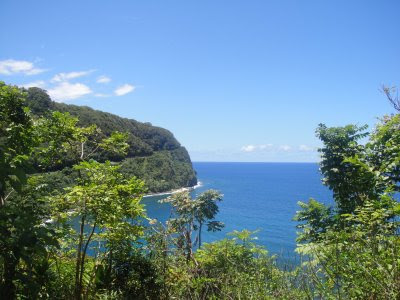
Ke'anae Coastline.

The above picture was taken at the Ke'anae coast and shows the coastline of that low-lying town has not changed much as compared to a thousand years ago. The one below shows a road seemingly cutting a densely forested peninsular in half. Both pictures were taken on the road to Hana in Maui. Last week I returned home after spending two idyllic weeks in Hawaii: five days in Oahu and nine days in Maui. Idyllic because the weather was perfect, it was off peak season so lines everywhere were short, and, for the first time, we did the drive to that quaint, quintessentially tropical town of Hana. The Road to Hana, as the entire endeavor is sometimes referred to, i.e. the drive, the many stops along the way, the distinctive foods- home made banana bread, lilikoi, papayas, mangoes, steamed breadfruit- that must be bought, the town itself, and the drive back can be a day long trip. We, on the other hand, decided to make it three days and two nights. And wisely so. After hearing stories and reading about the constant turns and downhills maneuvers on the Hana highway coupled with the fact that just the thought of all the curves is designed to give me notion sickness, I know we made a wise decision.

Hana Highway along east Maui.

We arrived in Kahului after four activity packed days on Oahu: kayaking, touring the LOST sights, snorkeling, touring the north coast. So by this time, we were ready for the laid back scene that is most of Maui. Kahului is a small port city and an airport town; consequently it is very commercialized and there aren't many good beaches, although some are within driving distance. This is not to say that I would overlook the town. In fact, I am always srtuck at the view of the West Maui mountains from here, its grandeur and yet its peacefulness. This time, however, Kahului served as our first pit stop before Hana. We'd have dinner and spend the night there, awaking refreshed and ready for the long drive ahead.

We started our drive the following morning after stopping for coffee at Maui Coffee Roasters, touted as the best coffee in west Maui, and I will have to agree. As with my previous trips to the islands, I relied on Maui Revealed, part of a series of guide books by Andrew Doughty which has now become my holy grail for everything Hawaii. His Maui edition has indepth descriptions of every must-see spot along the way, and those which can be overlooked. Since the highway sits between the edge of the mountain and the ocean, many of these sites include gorgeous waterfalls and gulches. And it wasn't long until we reached the first of the must-sees: Lower Puohokamoa Falls. If you don't know where to stop you'd probably pass the access point: nothing more than a small dirt pullout on the left side of the road, followed by a barded wire face, a short, very precarious trail, and you're at the viewing point directly across from the falls. This one was breathtaking, not because it was the first waterfall we encountered but its one hundred plus drop into the river below is simply majestic.... and frightening. It set the tone for the many other waterfalls we would see as we continued. Some even more majestic, some not as lofty but charming nonetheless.

Just when it seemed that the highway followed a distinct sequence - road, ocean view, tropical forest, waterfall, road, ocean view, forest, waterfall- we came upon the exit for Ke'anae, the quaint coastal town which, in 1946, was almost destroyed by a tsunami. The exit leads directly to Aunty Sandy's Banana Bread stand, in my opinion the best banana bread from Kahului all the way to Hana. (Yes, I tried them all; there was just no other way to make an informed opinion.) Their bread is made fresh, right then and there. Aunty Sandy somehow coincides her baking with each onslaught of visitors because the bread is still warm when you buy it. Having had our fill of warm banana bread and coconut candy, we drove past the stand and into the village itself. The further in you get, the magnitude of the unspoilt coastline begins to emerge. This is a prime example of what the islands looked like thousands of years ago, when hot lava met the ocean.

The sign in front of Aunty Sandy's Banana Bread stand.

Black Sand Beach at Wainapanapa State Park.

Back on the highway, it took us a little over an hour to finally get to Hana. Beautiful, mysterious, heavenly Hana. Never had I envisioned such a place existed in the United States. Most striking to me was the silence. No matter where we were, all we could here was either the ocean waves or the sound of the wind, and it's easy to understand why. With the exception of a general store which closes at seven pm, the two main hotels, a single gas station, and couple restaurants , commerce is almost nonexistent. And I am sure the prospect of the long drive from the main tourist center (central and west of the island) unofficially regulates the number of visitors there at any one time.

In spite of its remoteness, there is a lot to see and do in Hana. The famous Honokalani Black Sand Beach, picture-postcard-gorgeous Ohea Gulch, and family friendly Hana Bay. Then there is a visit to Ono Organic Farms, one of the highlights of the entire trip for me. Ono is hawaiian for delicious and everything is ono on this farm. From the welcoming cup of coffee to the very last piece of fruit. For thirty five dollars per person, owner Lily Boerner takes you on a tour through her tropical fruit tree paradise. Being an island girl myself, and having grown up on a similar style estate, this was like revisiting my childhood. Guavas, papayas, caimito (what I knew as caimet), soursop, passion fruit. I also had the opportunity to try news ones such as cheromoya, sweet passionfruit and a couple different varieties of bananas. As if that weren't enough, the farm sells organic coffee beans, jams, jellies, and spice rubs.

Standing in Oheo Gulch.

Fresh organic fruit from Ono Organic Farm. Clockwise from top right: papaya, lychee, guava, caimito, and pineapple.

Lily Boerner, owner of Ono Organic Farms, cutting into caimito and soursop.

For me, Hana was more than just another tourist attraction in Maui. It was a sanctuary, the ultimate hidden paradise. From its breathtaking natural formations, to its solitude, to the soothing sounds all around, to its fresh organic foods. It was a place where nothing else but the person you're with, and the moment you're in, mattered because everything else seems to be taken care of.

Wednesday, June 24, 2009

Pearl Cous Cous Salad with Fresh Mango and Cucumber


I came across an interesting article on the BBC which I thought would be an appropriate prelude to today's entry. Eat Less while Eating More talks about a new study by scientists of the British Nutrition Foundation who found that meals consisting of high water content foods tend to keep us feeling fuller for longer. The finding is that foods such as whole grains, yogurt, and those good old fruits and vegetables are digested slowly when compared to calorie dense, low water content foods such as peanuts, processed food products and candy. In addition, by replacing what's on our plate with mostly fruits and vegetables, we would consume a larger volume of food but less calories.

Sounds familiar, no? It is the age old advice for healthy living: eat more fruit and vegetables. An easy way to do so is to slip a couple extra servings into everyday meals. Such as this salad. It is teeming with cucumbers, red peppers and sweet, fresh mango. Like most salads, you can substitute whatever you happen to have on hand. Pineapple or chunks of peaches would definitely work, as would diced carrots or even fresh tomato wedges.


Pearl Cous Cous Salad with Fresh Mango and Cucumbers
Serves 4 to 5

1 1/2 cups pearl (israeli) cous cous
2 tbsp vegetable oil
1 tbsp grated fresh ginger
2 shallots, minced
2 star anise pods
1 3/4 cups vegetable broth
1 large cucumber, slices (about 2 cups)
2 cups fresh mango chunks ( about 2 average sized mangoes)
1 cup diced red pepper
1/4 cup chopped cilantro

Turmeric dressing
1/4 tsp turmeric
1/4 cup fat free or low fat sour cream
1 tbsp dijon mustard

1. Set a large pot over medium heat. Add vegetable oil, ginger, shallots, and star anise. Saute until shallots soften, about three minutes.
2. Add the cous cous and stir well to thoroughly coat each bead with the shallot mixture. Cook for an additional two minutes, until the cous cous browns slightly. Pour in the vegetable broth, stir and bring to a boil. Cover, reduce the heat and simmer until all of the liquid as been absorbed, an additional seven to eight minutes.
3. Meanwhile, prepare the turmeric dressing by combining all of the ingredients. Refrigerate until read to use.
4. Once the cous cous has cooked, discard the start anise pods. Toss cooked cous cous with cucumber, mango, red pepper, cilantro and turmeric dressing. Refrigerate until ready to serve.

Monday, June 15, 2009

Share Our Strength Minneapolis

Last Friday, Share our Strength held its Taste of the Nation benefit in Minneapolis. All proceeds went towards helping eradicate childhood hunger in America. Statistics show that approximately 700 00 thousand children in the United States experience hunger while more than 12 million live in homes where the concept of stable meals is not the norm but a daily battle for these families. (Progressive Policy Institute) Share our Strength is hoping to totally end this affliction by 2015. Visit their website for future events and other ways you can help this cause.

At Friday's event, restaurants from in and around the Minneapolis metro area offered samples of some of their signature dishes, as well as ones created specifically for the event. A couple of the highlights were the giant pot of paella served by Kitchen Window, and the passion fruit petits fours created by pastry chef Christina Kaelberer of Chambers.

I was also one of the judges at the mixology competition between Johnny Michaels from La Belle Vie and Birk Gruden from the Bradstreet Crafthouse. A tough job but someone had to do it. No, seriously, it was a tough job considering that they both are the top mixologists in the area. It was a close duel but at the end of the night, and after fervent taste-testing, Gruden emerged the winner.

Here are some photos of the evening.

The large pot of paella served by Kitchen Window. If you ever have to cook for 100, this is the pot for you.

Johnny Michaels and Birk Gruden doing what they do best.

With the other two judges: Mecca Bos-Williams of MetroMag, and Ezra Sauter, the lucky audience member.

With event chair Becky Opdyke.

Wednesday, June 10, 2009

Taste of Summer

While iced tea is probably the drink most synonymous with summer, I find that most could use a little something extra. A little more flavor, a little pizzaz so to speak. Enter the watermelon. Summer is the perfect time for fruity drinks and watermelon is the perfect fruit for summer drinks. Add fresh watermelon juice to freshly brewed tea and you have an exciting and refreshing summer drink.


Watermelon Peppermint Iced Tea
Serves 3 to 4

2 cups boiling water
2 bags of peppermint tea
4 lbs seedless water melon, cubed (about 6 cups)
honey (optional)

1. Pour hot water over the tea bags, cover and allow to brew for at least five minutes.
2. Meanwhile, puree the watermelon in a blender, strain and discard the pulp. In a large pitcher, add watermelon juice and tea. Sweeten with honey if desired and stir well. Chill before serving or serve immediately over ice cubes.